Saturday, 11 November 2017

CLASS-X SHORT ANSWER TYPE QUESTIONS (LIFE PROCESSES)


1.Name the product and by product of photosynthesis.
2.In which biochemical form the photosynthate moves in phloem tissue?
3.What are the raw materials of photosynthesis?
4.What is the similarity between chlorophyll and hemoglobin?
5.Name the products of photolysis of water.
6.What are the end products of light dependant reaction?
7.Which cell organelle is the site of photosynthesis?
8.What is the difference between digestion of heterotrophs and saprotrophs?
9.Give example of two plants and two animal parasites.
10.Name the enzyme present in saliva, what is its role in digestion?
11.Which chemical is used to test for starch? Which colour shows the presence of starch?
12.Give the term- rhythmic contraction of alimentary canal muscle to propel food.
13.Name the three secretions of gastric glands.
14.What is the function of mucus in gastric gland?
15.Name the sphincter which regulates the exit of food from the stomach.
16.Give the functions of hydrochloric acid for the body.
17.What is the role of pepsin in stomach?
18.Why pancreas is called mixed gland?
19.Give two functions of bile juice, from which organ it is released?
20.Name the largest gland of our body.
21.Name any three important enzymes of pancreas and the food component on which they act.
22.Where from intestinal juice come to the small intestine?
23.What is the function of intestinal juice?
24.What are the simplest digestive product of carbohydrate, fats and protein?
25.Name the finger like projections of small intestine and what is the necessity of such type of projections in digestive system?
26.Why are intestinal villis highly vascular?
27.What is the function of anal sphincter?
28.Name the site of anaerobic and aerobic respiration in a cell.
29.A three carbon compound is the common product of both aerobic and anaerobic pathway. What is that?
30.Why do we get muscle cramp after vigorous exercise?
31.Distinguish between lactic acid and alcoholic fermentation?
32.Name the energy currency molecule of cell?
33.The breathing rate of aquatic animals is high, why?
34.What is the function of mucus and fine hair in nostrils?
35.Give the function of network of capillaries on alveoli.
36.Name the main carrier of oxygen and carbon dioxide in man.
37.Why does haemoglobin molecule act as efficient carrier of oxygen than diffusion process?
38.Give example of any three substances transported by plasma.
39.Name the organ that- (a) pushes blood around body (b) make blood to reach to tissues.
40.Name the blood vessel that carries blood from heart to lungs and from lungs to heart.
41.How many heart chambers are there in (a) fish (b) frog (c) lizard (d) crocodile (e) birds (f) man?
42.Name the device that measures blood pressure.
43.What is the normal blood pressure of man?
44.Why capillaries are thin walled?
45.Which cell of blood help in wound healing?
46.What is the other name of lymph?
47.Give two function of lymph.
48.What is the direction of flow of water in xylem and food in phloem?
49.Why do plants need less energy than animals?
50.Which process acts as suction to pull water from xylem cells of roots.
51.Mention two functions of transpiration.
52.What are the two substances transported through phloem tissue?
53.Name the food component whose digestion produce nitrogenous waste?
54.Which is the functional unit of kidney?
55.What is the cup shaped structure of nephron called?
56.Which materials are selectively reabsorbed by nephron tubule?
57.What are the two important functions of kidney.
58.What is the other name of artificial kidney?


ANSWERS

1.Product-starch by product-oxygen
2.Sucrose.
3.carbon dioxide, water
4.both are pigments
5.oxygen, electron and protons
6.ATP, NADPH2
7.chloroplast
8.Heterotrophs- digestion occurs inside the body, saprotrophs- digestion occurs outside of body.
9.plant-cuscuta, orchid animal-lice, tics
10.Salivary amylase-It digests starch to maltose.
11.Iodine solution, blue
12.Peristaltic
13.HCl, pepsin, mucus
14.Protects the inner lining of stomach from the action of acid HCl.
15.Pyloric sphincter
16.Activates pepsin, make the medium acidic for enzyme action, Microcidal.
17.Pepsin digests protein into peptones.
18.It behaves as exocrine as well as endocrine gland.
19.(i)Emulsifies fat (ii) Change the food medium into alkaline on which pancreatic enzyme can act.
20.Liver
21.(i)Amylase- carbohydrate, (ii) Lipase- fat, (iii) Trypsin- protein.
22.Secreted from internal wall of small intestine.
23.Perform final digestion of all food components.
24.(i) carbohydrate- glucose, (ii)fat- fatty acid, glycerol (iii) protein- amino acid.
25.Villi, Increase the surface area of absorption of digested food.
26.More the blood supply, the more will be the absorption of digested food.
27.Regulate the exit of waste material.
28.Anaerobic-cytoplasm, aerobic- mitochondria.
29.Pyruvic acid.
30.Because of the accumulation of lactic acid which is formed due to anaerobic break down of glucose.
31.Lactic acid is a 3 carbon compound produced on oxidation of glucose anaerobically where as ethanol a 2 carbon compound is formed on anaerobic oxidation of glucose along with co2.
32.ATP
33.Because they take dissolved oxygen whose percentage in water is lower than atmospheric percentage.
34.Filter impurities.
35.Exchange of gases by diffusion process. Oxygen from lungs moves to blood and carbon dioxide from blood moves to lungs.
36.O2(-ve)haemoglobin, O2(-ve)plasma.
37.Haemoglobin has high affinity for oxygen, so it carries the gas faster in blood where as diffusion is a slow process.
38.Digested food, carbon dioxide, nitrogenous waste.
39.(a) Heart, (b) blood vessel.
40.(a) Pulmonary artery, (b) pulmonary vein.
41.(a) 2, (b) 3, (c) 3, (d) 4 (e) 4 (f) 4.
42.Sphygmomanometer
43.120/80
44.For exchange of materials by diffusion process.
45.Platelet cells.
46.Tissue fluid.
47.Carries digested and absorbed fats, drains excess fluid from extra cellular space to blood.
48.Flow of water is unidirectional i.e. from root to leaves, but flow of food bidirectional i.e. leaf to sink and vice versa.
49.Plants are nonmotile; most of the cells are dead.
50.Transpiration.
51.(i)Absorption and upward movement of water and minerals, (ii) temperature regulation.
52.Sucrose, amino acid.
53.Protein, nucleic acid.
54.Nephron.
55.Bowman’s capsule.
56.Glucose, amino acids, salts, water.
57.Filtration of nitrogenous waste from blood and osmoregulation.
58.Dialysis.

Tuesday, 7 November 2017

MANAGEMENT OF NATURAL RESOURCES

Natural  Resources:

Anything in the environment ‘which can be used’ is called ‘natural resource’. Natural resources include total natural environment that support human life and contribute to the production of necessities and comforts to mankind. So natural resources are the components of atmosphere, hydrosphere and lithosphere. 

On the basis of abundance and availability, the natural resources are of two types: 
(a) Inexhaustible (b) Exhaustible. 


(a) Inexhaustible. These are in plenty and cannot be exhausted by man’s consumption e.g., air, sand, 
clay etc, affected by over-population of mankind. (b) Exhaustible. These are limited and can get exhausted over a period of time. i.e., coal, petroleum 
etc. 

Management of Natural Resources

A system of controlling the use of natural resources in such a way as to avoid their wastage and to use 
them in the most effective way is called management of natural resources. 

Why do we Need to Manage Our Resources: 

We need to manage our natural resources because of the following reasons: 

1. The resources of the earth are limited. Because of the rapid increase in human population, the demand for resources is increasing day by day. The proper management can ensure that the natural resources are used judiciously so that they fulfill the needs of present generation and also last for the generations to come. 

2. The proper management of natural resources takes into consideration long-term perspective (or view) and prevents their exploitation to hilt for short-term gains. 

3. The proper management can ensure equitable distribution of natural resources so that all the people can benefit from the development of these resources. 

4. The proper management will take into consideration the damage caused to the environment during the ‘extraction’ or ‘use’ of the natural resources and find ways and means to minimize this damage. 

Conservation of Wildlife

It is very important to conserve wild-life to maintain the ecological balance in nature and to preserve the 
gene pool. Some of the measures (or steps) to be taken for the conservation of wildlife are given below: 

1. Laws should be made to impose a total ban on the poaching (killing) or capturing of any animal or bird belonging to an endangered species. The poaching of an endangered species of animals and birds should be made a punishable offence. Such laws should not remain on paper only, they should be enforced strictly. 

2. The natural habitats of wild animals and birds should be preserved by establishing National Parks and anctuaries throughout the country. 

3. The government Department connected with the conservation of wildlife should conduct a periodic survey in all the forests, National parks and Sanctuaries to have knowledge of the population of all species of wild animals and birds, so that these animals can be helped in the times of distress like floods and famines. 

4. Special attention should be paid to the conservation of endangered species of wild animals and birds to prevent their extinction altogether. 

5. The unauthorized felling (cutting) of forest trees for timber trade and fuel-wood should be curbed 
(stopped) immediately. This is because depletion of forests destroys the natural habitat of wild animals and birds, and exposed them to he cruelty of man as well as nature. 

6. In the case of Government authorized felling of forest trees, for every acre of forest cut down, an equal area of land should be planted with saplings of trees to make up for the loss in the long run. 

Advantages of Dams:

1. Water from a dam is used for irrigation in fields through a network of canals. Dams ensure round the year water supply to the crop fields and help raise agricultural production. 

2. Water from a dam is supplied to the people in towns and cities through pipelines after suitable treatment. In this way, construction of dams ensures continuous water supply in the region. 

3. The falling water (or flowing water) from the dam is used for generating electricity. The water rushing down the dam turns turbines which run electric generators. 

Disadvantages of Dams:-

1. Social problems. Due to the construction of high-rise dams, a large number of human settlements (or villages) are submerged in the water of large reservoir formed by the dam and many people are rendered homeless. This creates a social problem. 

2. Environmental Problems. The construction of high –rise dams on the rivers contributes to deforestation and loss of biodiversity. This is because a vast variety of flora and fauna (plants and animals) get submerged in the water of large reservoir formed by the dam and disturb the ecological balance. 

3. Economic Problems. Some people say that the construction of high-rise dams involves the spending of huge amount of public money without the generation of proportionate benefits. 

Forests:-

Forests are important renewable natural resources dominated mainly by trees forming a sort of canopy they are essential for ecological balance of all ecosystems. They maintain biological diversity, prevent floods and safeguard future of tribals. 
The forests, cover a wide range of life forms including bacteria, fungi, ferns, gymnosperms, flowering plants, nematodes, insects, birds, reptiles and mammals. They need conservation in order to preserve the biodiversity we have inherited. Various studies have shown that a loss of diversity may lead to a loss of ecological stability. 

Conservation of Forests:

Conservation is protection, augmentation and scientific management of resources so as to maintain them at their optimum level providing benefit to the present as well as future generations. Forests and regulative 
properties. It is carried out by the following methods.

1. Afforestation. It is growing of forests on unprotected barren lands. Van Mahotsava is a tree plantation movement carried out twice a year (February and July) by both government and voluntary agencies. 

2. Reforestation. It is developing forest cover in the area which has been damaged or cleared during  exploitation. 

3. Separation Separation of Commercial Forestry. of Commercial Forestry. Useful plants required by industry should be planted separately preferably on waste land. Growing industry required plants is called production plantation. 

4. Grazing. Grazing should be regulated according to the availability of pasturage. 

5. Sustained Yield Block Cutting. A forest is divided into a number of blocks depending upon the period required by forest trees to mature. In one year trees of one block are felled. The block is reforested 
immediately. In this way annual deforestation is compensated by annual reforestation. The forest is conserved indefinitely and provides sustained yield. 

Effects of Deforestation:- 

Removal, decrease or deterioration of the forest cover of an area is called deforestation. It ois caused buy 
excessive felling of trees, overgrazing, monoculture, fragmentation and clearing of forests. 

Deforestation causes. 

1. Soil Erosion. Removal of plant cover exposes the fertile soil to wind and water. Te latter remove the top soil and make the area infertile. 

2. Desertification. Removal of forest cover in the plains makes the area dry. In hot season, the soil becomes loose. Air currents take away the fine soil particles leaving behind sand. 

3. Floods. In rainy season many temporary rivulets are formed due to loss of absorption capacity by unprotected soil. The rivulets produce floods in low land causing loss to agriculture, property and life. 
4. Destruction of wildlife. Deforestation leads to destruction of natural habitats of wild animals and plants. Wildlife is, therefore, destroyed. 

5. Climatic changes. In the absence of forest cover, the summer becomes hotter while the winters become extra cool. The frequency of rainfall decreases. 

Chipko Movement:- 

Chipko-Movement was born in Nineteen seventees in a small hilly village of the upper reaches of Himalayas. Tribal people of Tehri-Garhwal district of U.P realized the importance of the forests and  decided against giving its products to the people of other areas. They stood against the ruthless butchery  of nature and the axes of greedy contractors. At the initial stage of the movement (in December,1972), the women of Advani village in Tehri-Garhwal protested against indiscriminate felling ot trees.

 In March 1973, a sports goods factory was to cut ten ash tress near the village Mandal in Chamoli district. The local people prevented the same by hugging (vern. Hindi Chipko) the marked trees. In 1974, a group of women led by Gaura Devi successfully prevented felling of trees near village Reni. The movement became famous in 1978 when the women of Advani village in Tehri-Garhwal faced policed firing and later courted arrest. The chipko Movement spread slowly to all nearby areas under the leadership of shri Sunderlal Bahuguna of Silyara in Tehri region and Shir Chandi Prasad Bhatt of Gopeshwar. Sunderlal 
Bahugna is now a world famous figure; he presented his plan of this movement at the UNEP meeting held in London in June 1982. 
Thus,  Chipko Movement (i.e., chipko Andolan) is the tree hugging movement in which the villagers compel the axeman to stop tree felling by embracing and forming ring(circle) around the marked trees. 

Watershed Management:-

Watershed is a high raised area which is source of run off to low lying areas. Growing more trees in watershed areas increases retention of more rain water and protection of soil from erosion. Therefore, watershed management develops the primary resources of land and water. It enhances the evelopment of secondary resources of plants, animals and other biota. The enhanced productivity increases the income of watershed community. There are fewer droughts and floods downstream. Silting of downstream dams and reservoirs is also reduced. 

Rainwater Harvesting:- 

Water harvesting is capturing, collection and storage of rain water and surface run off for filling either small water bodies or recharging ground water so that water continues to be available in non-rainy seasons. 

Water harvesting designs for rain - fed areas in J&K State: Various designs have been recommended depending on the soil, topography climate, size of the land  holding, etc. which could be practiced: 

1. Contour cultivation. Contours are made across the slope and in this cultivation of crops, trees etc is carried out. These contours would form barriers across the flow path of runoff. It is the most effective on moderate slopes. The water is collected in the depressions. 

2. Contor Vunding. Contor Vunding... It is the most popular method practiced on large scale. The practice comprises of constructing narrow based bunds on contour to impound runoff water behind them, so that 
impounded water is absorbed gradually into the soil profile. The bunds are normally impouned up to a height of 30 cms. The bunds should be constructed from the top of the catchment and preceded downwards. 

3. Bench Terracing. Bench terracing is another popular method practiced on steep hilly slopes where agriculture practices are common. Bench terracing involves converting the original ground into level step like fields constructed by half cutting and half filling, which reduces the degree of the slope. 

4. Strip farming. Strip farming. The cropping is usually intermittent on strips or in rows with catchment area left fallow. The principle lying behind this process is to collect runoff from catchment area to improve 
soil moisture on the cropped area. 

5. Storing Runoff Water for Recycling. In semi-arid areas, summer rainfall is short in duration and comprises of limited rainy days. The intensity or rainfall is high which gives high runoff. This is because high intensity of rainfall has low infiltration rate and runoff rate is therefore, very high. Therefore, catchment area, which has low-lying region, is selected and bunded for collection of runoff water.

6. Chek Dams Construction on Nallas and Off- Chek Dams Construction on Nallas and Off---Stream. It is a process in which construction of bunds of suitable dimensions across Nalla or stream to hold maximum runoff water to create temporary flooding in the streams with arrangements to drain water at suitable intervals is carried out. The water released from bunds. 

Coal and Petroleum Conservation:- Coal and petroleum are fossil fuels found in earth’s crust. They are non-renewable and exhaustible resources. 

1. Coal. Coal is combustible fossilized rock derived from a large accumulation of plant remains that is gradually compressed. About 6000 billion tons of coal lies under the earth and by now more than 200 billion tons had been used. it occurs widespread in many countries including Japan, China, Russia, U.K., U.S.A., Poland,Kuwait , Saudi Arabia, Iran, Iraq, Nigeria, Libya, Indonesia and India. Coal is used for cooking, heating, in industry and thermal power plants. 

2. Petroleum. Petroleum is another fossil fuel that occurs in the form of liquid –oil. It has been formed in the past (about 10 to 20 crore years old) from plant and animal remains and occur in the form of mineral oil in sedimentary rocks. Petroleum reserves are confined to a few countries. 
In India, oil bearing area is estimated to be over a million square km/ petroleum is mainly used as fuel for transport, agricultural operations, generators and some industries. 

Methods of Conservation of fossil fuels: 
1. Burning of coal causes air pollution. Thus m direct use of coal for the purpose or burning should be avoided. Coal may be converted into liquid fuel and compressed natural gas (CNG) through coal gasification. 

2. Techniques should be developed to recover maximum fossil fuel that lies in deep mines and wells. Wastage during extraction and transportation should be avoided. 

3. Both oil wells and coal mines a prone to catch fires. Therefore, these should be well protected from fire to avoid wastage pollution and loss of life and property. 
4. Over-consumption of oil in automobiles should be checked. We must save oil for future use because only a few years are left for its depletion. 

5. Alternative sources of energy, such as hydroelectric, nuclear, solar, wind power and biogas plans 
should encouraged 

Some Important Terms

National Park:-
A national park is a large area where one or several ecosystems exist and where plant and animal species, geomor phological sites and habitats are of special educating and recreative interest. 

Sanctuary:- Wildlife sanctuary is a large area dedicated to protect wildlife and conserve species. Hunting is not allowed in a sanctuary. 

Endangered species: -All those species of plants and animals which are liable to become extinct are called endangered species. E.g., snow orchid, Rhus hoolari, Indain wolf, Assam rabbit. 

Vulnerable species:- Are those species that are vulnerable to get extincted. These are few in number and are in danger of becoming extinct. These are protected under law.

Rare species:- Rare species are those species that are threatened of extinction. Their numbers are few or 
they live in such small area or in such unusual environment s that they could quickly disappear. 

Extinct species : Species that have no living members are said to be extinct. Extinct species are known 
through the fossil record. e.g., dinosaurs, mammoth, sabertooth etc. 

Khadins:- khandins are earthern embankments down the slope of catchment areas which help in retaining run off water. A dug well is often located behind that embankment to store extra run off if it happens to  overflow the embankment. Slowly the stored water perlocates down into the ground. 

Abbreviations:-  
UNEP    : Unite nation’s environment programme. IPCC    : Intergovernmental panel on climatic change. GAP     : Ganga action plan. RS         :Reduce, recycle, re-use. 
BOD    : Biochemical oxygen demand. 


Tuesday, 31 October 2017

Our Environment Important Questions Class 10

SHORT ANSWER TYPE QUESTION[II] [3 Marks] – Year 2007
1. (a) What is ‘environmental pollution’?
(b) Distinguish between biodegradable and non-biodegradable pollutants.
(c) Choose the biodegradable pollutants from the list given below:
Sewage, DDT, radioactive waste, agricultural waste. [Delhi]
Answer. (a) Environmental pollution is an undesirable change in the physical, chemical or biological

characteristics of the natural environment, brought about by man’s activities. This pollution may affect the soil, rivers, seas or the atmosphere.


(c) Biodegradable pollutants are sewage and agricultural waste.
VERY SHORT ANSWER TYPE QUESTIONS [1 Mark] – Year 2008
2. How is the increase in demand for energy affecting our environment adversely?
Answer. The increase in demand for energy affects our environment adversely. Due to this increase, pollutants like CO,C0, S02, etc., are released in to the atmosphere which leads to greenhouse effect.
3. Why is ozone layer getting depleted at the higher levels of the atmosphere? [Delhi (C)]
Answer. Ozone layer is getting depleted at the higher levels of the atmosphere due to effect of chlorofluorocarbons (CFCs) which are used as refrigerants and in fire extinguishers.
4. Name any two abiotic components of an environment. [Delhi (C)]
Answer. Two abiotic components of an environment are temperature and rainfall.
SHORT ANSWER TYPE QUESTION[II] [3 Marks] – Year 2008
5. Why are bacteria and fungi called decomposers? List any two advantages of decomposers to the environment. [Delhi]
Answer. Bacteria and fungi breakdown the dead remains and waste products of organisms. These micro organisms are called the decomposers as they breakdown the complex organic substances into simple inorganic substances that go into the soil and are used up once more by the plants.

Two advantages of decomposers to the environment are as follows:
  1. Decomposers feed, on the dead bodies of plants and animals. They return the simple components to soil and help in making the steady state of ecosystem by recycling of nutrients. They, therefore, create a balance in the environment.
  2. They also act as scavengers or cleansing agents of the atmosphere.
VERY SHORT ANSWER TYPE QUESTIONS [1 Mark] – Year 2009
6. What are the two main components of our environment? [Delhi]
Answer. The two main components of our environment are the biotic or living components and abiotic or non-living components.
7. Why are green plants called ‘producers’? [All India]
Answer. Green plants are called ‘producers’ because they can produce food by photosynthesis in the presence of sunlight.
8. Which disease is caused in human beings due to depletion of ozone layer in the atmosphere? [Foreign]
Answer. Skin cancer is caused in human beings due to the depletion of ozone layer in the atmosphere.
SHORT ANSWER TYPE QUESTIONS [II] [2 Marks] – Year 2009
9. How is ozone formed in the upper atmosphere? Why is the damage of ozone layer a cause of concern to us? State a cause of this damage. [Delhi(C)]
Answer. Ozone is formed in upper atmosphere by the reaction of ultraviolet (UV) radiations on oxygen (02) molecule.

The damage to ozone layer is a cause of concern to us as due to its damage, more ultraviolet rays reach the earth’s surface causing various health hazards.


A cause of this damage is the presence of large amount of chlorofluorocarbons in the atmosphere.
10. State two problems caused by the non- biodegradable waste that we generate in our daily life. [All India (C)]
Answer. Two problems caused by non-biodegradable waste that we generate in our daily life are:
  1. It clogs drains.
  2. It causes water and soil pollution.
11. What are biodegradable and non- biodegradable substances? Select two biodegradable pollutants from the following: Agricultural waste, glass, plastic, sewage, DDT. [Ail India (C)]
Answer. Biodegradable substances are those substances which are broken down into simpler, harmless substances in nature in due course of time by the biological processes such as micro organisms like certain bacteria.

Non-biodegradable substances are those substances which cannot be broken down into simpler, harmless substances in nature.

Two biodegradable pollutants are agricultural waste and sewage.
SHORT ANSWER TYPE QUESTIONS [I] [2 Marks] – Year 2010
12. Construct an aquatic food chain showing four trophic levels. [All India]
Answer. Food chain in aquatic ecosystem:
13. Explain ‘biological magnification’ with the help of an example. [All India]
Answer. Pesticides used in crops are washed down .into the soil. From soil these are absorbed by plants along with water and minerals and thus, they enter the food chain. While consuming the crops, human beings also consume these pesticides which get accumulated in our bodies. This phenomenon is known as biological magnification.
14. Describe how decomposers facilitate recycling of matter in order to maintain balance in the ecosystem. [Foreign]
Answer. Decomposers are micro organisms that obtain energy from the chemical breakdown of dead organisms of animals or plants. These micro organisms breakdown the complex organic substances of dead organisms into simple inorganic substances that go into the soil and are used up once more by the plants. Decomposers thus, help in recycling of matter.
15. Explain the phenomenon of “biological magnification” How does it affect organisms belonging to different trophic levels particularly the tertiary consumers? [Delhi]
Answer. The process in which harmful chemicals enter a food chain and get accumulated progressively at each trophic level is called biological magnification.

Harmful and toxic chemicals enter our bodies when they are added to soil and water. Use of pesticides to protect the food crops from diseases and pests and chemical wastes of factories are dumped in open or disposed off into rivers. These chemicals are washed down into the soil and ultimately to water table or get absorbed or taken up from the soil by the plants along with water and minerals and in this way harmful chemicals enter the food chain. The quantity of these harmful chemicals increase with increase in trophic level of the food chain because these substances are not degradable. Man is at the top of the food chain, so concentration is maximum in human beings.

Thus, accumulation of DDT has been maximum in man as DDT is used to destroy pests. DDT is accumulated in the following way in this food chain:

This is the reason why our food grains such as wheat and rice, vegetables and fruits and even meat contain varying amounts of pesticides residues. So, the highest trophic level at the extreme right of food chain has the maximum concentration of harmful chemicals in a food chain.
16. “Damage to the ozone layer is a cause for concern.” Justify this statement. Suggest any two steps to limit this damage. ‘ [Delhi]
Answer. Ozone layer prevents the harmful ultraviolet radiation to enter the atmosphere and reach the earth’s surface. Depletion of ozone layer has become a cause for concern because it can cause serious effects on human body and other organisms of the environment like fatal diseases such as skin cancer, changes in genetic material DNA, eye damage, etc.

Two steps to limit this damage are as follows:
  1. Judicious use of aerosol spray propellants such as fluorocarbon and chlorofluorocarbons which cause depletion or hole in ozone layer.
  2.  Control over large scale nuclear explosions and limited use of supersonic planes.
VERY SHORT ANSWER TYPE QUESTIONS [1 Mark] – Year 2011
17. What will happen if we kill all the organisms in one trophic level? [Delhi]
Answer. If we kill all the organisms in one trophic level, the following effects will take place:
  1. The population of organisms in previous trophi’c level will increase.
  2. The organisms in next trophic level will not be able to get the food, so they will migrate to some other ecosystem or die.
  3. It will cause an ecological imbalance in the food chain.
18. Why did United Nations act to control the production of chlorofluorocarbons (CFCs) used in refrigerators? [Delhi]
Answer. CFCs deplete the ozone layer around the earth, hence their production is controlled by United Nations.
19. Which compounds are responsible for the depletion of ozone layer? [Delhi]
Answer. The compounds responsible for the depletion of ozone layer are chlorofluorocarbons (CFCs).
20. Define ‘trophic level’. [Delhi]
Answer. Trophic level is the position that an organism occupies in a food chain, where transfer of food or energy takes place.
21. What are the various steps in a food chain called? [Delhi]
Answer. The various steps in a food chain are called trophic levels.
22. What is the important function of presence of ozone in earth’s atmosphere? [Delhi]
Answer. The important function of presence of ozone in earth’s atmosphere is that it shields the surface of the earth from ultraviolet (UV) radiations of the sun.
23. Give an example to illustrate that indiscriminate use of pesticides may result-in the degradation of the environment. [All India]
Answer. The pesticides used in crop field are washed down into the water bodies. From water bodies, these are absorbed by aquatic plants and animals of a food chain and thereby degrades the environment.
24. Why is it necessary to conserve our environment? [All India]
Answer. It is necessary to conserve our environment to prevent depletion of natural resources and environmental damage, thereby sustaining life.
25. What is meant by a biodegradable waste? [All India]
Answer. Biodegradable wastes are those substances which are broken down into simpler, harmless substances in nature in due course of time by the biological processes such as action of micro organisms like certain bacteria.
Examples: Urine and faecal matter, sewage, agricultural residue, paper, wood, cloth and cattle dung.
26. What is the role of decomposers in the ecosystem? [Foreign]
Answer. Role of decomposers in the environment:
  1. They return the nutrients to the nutrient pool.
  2. They help in completing the different bio-geochemical cycles, thus they maintain the balance in the ecosystem.
27. What step is being taken to limit the damage to the ozone layer? [Foreign]
Answer.
  1. Judicious use of aerosol spray propellants such as fluorocarbon and chlorofluorocarbons which cause depletion or hole in ozone layer.
  2. Control over large scale nuclear explosions and limited use of supersonic planes.
28. Why are some substances non- biodegradable? [Foreign]
Answer. Some substances are non-biodegradable because they cannot be broken down into simpler harmless substances in nature.
29. Which class of chemicals is linked to the decrease in the amount of ozone in the upper atmosphere of the earth? [Delhi]
Answer. The chemical compound Chlorofluorocarbon is responsible for decrease of ozone in the upper atmosphere of the earth.
30. Name two decomposers operating in our ecosystem. [All India 2011; Delhi]
Answer. Bacteria and fungi.
31. Select two non-biodegradable substances from the following waste generated in a kitchen: spoilt food, paper bags, milk bags, vegetable peels, tin cans, used tea leaves. [Delhi]
Answer. Milk bags and tin cans.
32. What happens when higher energy ultraviolet radiations act on the oxygen at the higher level of the atmosphere? [All India]
Answer. When high energy ultraviolet radiations act on oxygen, ozone is produced:
33. In a food chain, 10,000 joules of energy is available to the producer. How much energy will be available to the secondary consumer to transfer it to the tertiary consumer? [All India ]
Answer. 10 J will be available to the secondary consumer to transfer to the tertiary consumer.
34. Write the name and formula of a molecule made up of three atoms of oxygen. [All India]
Answer. Ozone and its chemical formula is O3.
35. List two man-made ecosystems. [All India]
Answer. Garden and Pond are man-made ecosystems.
36. Consider the following food chain which occurs in a forest: Grass -> Deer -> Lion
If 10000 J of solar energy is available to the grass, how much energy would be available to the deer to transfer it to the lion? [Foreign]
Answer. 10 J energy would be available to deer to transfer to lion.
37. Which of the following belong to the first trophic level of a food chain? Grass, Grasshopper, Plants, Rat, Tiger [Foreign]
Answer. Grass and plants belong to the 1st trophic level of a food chain.
38. Name the phenomenon in which non-biodegradable chemicals get accumulated progressively at each trophic level of a food chain. [Foreign]
Answer. Biological magnification.

Other Important Questions 
1.Why is there a need to b an the use of poly then e bags?

Ans.Polythene bags are non- biodegradable, the y are not decomposed by micro- organisms hence, cause land pollution. 
2.What are the two functions of ecosystem?

Ans.Interactions of any ecosystem refers to it s functions these interactions are- 

(A) Biogeochemical cycles- The cyclic transfers between the living and non- living components. 

(B) Flow of energy- in a food chain, through various st eps of eating and being eaten food energy flow from one tropic level t o another. 


3.What percentage of solar energy is trapped and utilized by plants? 

Ans.Plants utilized only 1% of total sun’s ener gy, which is utilized by plants in the process of photosynthesis. 
4.Energy transfer is said to be unidirectional wh e r e as biochemical transfer is said be cyclic. Why? 

Ans.Energy flow is unidirectional because as it transfers from one trophic level to next trophic level, it reduces only 10% is available at Successive level from previous level. Nutrient flow is cyclic because nutrients re turned back into nutrient pool from the dead bodies of plants and animals by the d ecomposition of micro- organisms from nutrient pool. They are utilized aga in by plants. 
5.Give difference between produc es and consumers. 

Ans.
6.There are no predators for tiger or lion. Why? 

Ans. Lions and tigers are at the highest trophic level. They are largest animals which feed upon the secondary carnivores like wolves etc. they are not killed and eaten by other animals. 
7.What are the measures to protect ozone depletion?

Ans..Measure to protect ozone layer- 

(A) Concern over increasing global ozone depletion led to international restrictions in the use and manufacture of CFCS and halons. 

(B) International concern over the seriousness of the problems associated with ozone layer depletion led to the adoption of Vienna convention for the protection of the ozone layers in 1985.

(C) Promotion of an international treaty know

Our Environment for class 10 sec_2


Introduction

→ Everything that surrounds us is environment. It includes both living (biotic) and non-living (abiotic) components.

→ Interaction between these biotic and abiotic components form an ecosystem.

→ In an ecosystem living components depend on each other for their food which give rise to food chains and food webs in nature.

→ Human activities lead to environmental problems such as depletion of ozone layer and production of huge amount of garbage.

Ecosystem

→ All the interacting organisms in an area together with the non-living constituents of the environment form an ecosystem. E.g., forest, pond etc.

Types of ecosystem

It is of two types
(i) Natural ecosystem: The ecosystem which exist in nature on its own.
Example: forest, lake, ocean.

(ii) Artifical ecosystem: Man-made ecosystems are called artificial ecosystem. 
Example: crop field, aquarium, garden.


(i) Abiotic Components: All the non-living components such as air, water, land, light, temperature etc. form the abiotic components.

(ii) Biotic Components: All the living components such as plants, animals, bacteria, fungi etc. form the biotic components.

• On the basis of nutrition biotic components are further divided into:

→ Producers: All green plants and blue-green algae can produce their own food using abiotic components (photosynthesis), hence called producers.

→ Consumers: Include all animals which depend on producers directly or indirectly for their food.

Division of Consumers

(i) Herbivores: Plant eaters. Example:  goat, deer.

(ii) Carnivores: Flash eaters. Example: tiger, crocodile.

(iii) Omnivores: Eats both plants and animals. Example: human.

(iv) Parasites: Live on the body of host and take food from it. Example: lice, cascuta.

Decomposers: Include organisms which decompose the dead plants and animals. Example: bacteria, fungi. These help in the replenishment of natural resources.

Food Chain

→ Food chain is a series of organisms in which one organism eats another organism as food. For example:
• Grass → Deer → Lion

→ In a food chain various steps where transfer of energy takes place is called a trophic level.

Flow of energy between trophic levels


→ Flow of energy in a food chain is unidirectional.

→ Green plants capture 1% of sunlight and convert it into food energy.

→ 10 percent law : Only 10% of energy is transferred to the next trophic level. The remaining 90% energy is used in life processes (digestion, growth, reproduction etc.) by present trophic level.

→ Due to this gradual decrease in energy, food chains contain 3-4 trophic levels.
Trophic levels

• Decrease in energy
1 kJ ↣ 10 kJ ↣ 100 kJ ↣ 1000 kJ

• Biological magnification: The concentration of harmful chemicals increases with every next trophic level in a food chain. This is called biological magnification.

→ Maximum concentration of such chemicals get accumulated in human bodies as human occupy the top level in any food chain.

Food web

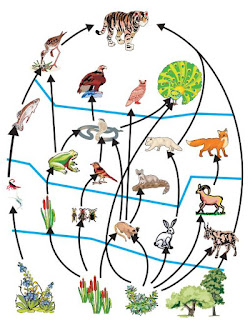
→ In nature large numbers of food chains are interconnected forming a food web.

• Environmental problems: Changes in the environment affect us and our activities change the environment around us. Human activities leads to pollution, deforestation etc.

Ozone layer

→ Ozone layer is a protective blanket around the earth which absorbs most of the harmful UV (ultraviolet) radiations of the sunlight, thus protecting living beings from many health hazards such as skin cancer, cataract, destruction of plants etc.

→ Ozone (O3) layer is present at higher levels of atmosphere (i.e. stratosphere). It is a deadly poison at ground level.

Formation of ozone molecule

(i) The high energy UV radiations break down the Omolecules into free oxygen (O) atoms.
O →(UV)  O + O (atoms)

(ii) These oxygen atoms then combine with oxygen (O2) molecule to form the ozone molecule.
O2 + O → O(ozone)

Depletion of ozone layer

→ The decrease in the thickness of ozone layer over Antarctica was first observed in 1985 and was termed as ozone hole.

→ This decrease was linked to excessive use of synthetic chemicals like chlorofluorocarbons (CFCs) which are used in refrigerators, ACs, fire-extinguishers, aerosols sprays etc.

→ United Nations Environment Programme (UNEP) succeeded in forging an agreement to stop CFC production at 1986 levels (KYOTO PROTOCOL) by all countries.

Garbage disposal

→ Improvements in lifestyle have resulted in accumulation of large amounts of waste materials.

Types of materials in Garbage

(i) Biodegradable: Substances which can be decomposed by the action of micro-organisms are called biodegradable wastes.

Example:  fruit and vegetable peels, cotton, jute, dung, paper, etc.

(ii) Non-biodegradable wastes:Substances which cannot be decomposed by the action of micro-organisms are called non-biodegradable wastes.

Example: plastic, polythenes, metals, synthetic fibres, radioactive wastes, pesticides etc.

→ Micro-organisms release enzymes which decompose the materials but these enzymes are specific in their action that’s why enzymes cannot decompose all the materials.

Methods of waste disposal

(i) Biogas plant: Biodegradable waste can be used in biogas plant to produce biogas and manure.

(ii) Sewage treatment plant: The drain water can be cleaned in sewage treatment plant before adding it to rivers.

(iii) Land fillings: The wastes are buried in low lying areas and are compacted by rolling with bulldozers.

(iv) Composting: Organic wastes are filled in a compost pit and covered with a layer of soil, after about three months garbage changes to manure.

(v) Recycling: Non-biodegradable wastes are recycled to make new items.

(vi) Reuse: It is a conventional technique to use an item again. Example: newspaper for making envelops.